
Kathmandu Pokhara & Chitwan – 12 Days
Trip Highlights of Kathmandu Pokhara & Chitwan – 12 Days
- Discover Kathmandu’s narrow alleyways and holy sites.
- To see Mount Everest, take a flight via the Himalayas.
- Take a rafting trip along the Trishuli River.
- Start a quick hike through the Annapurna Foothills.
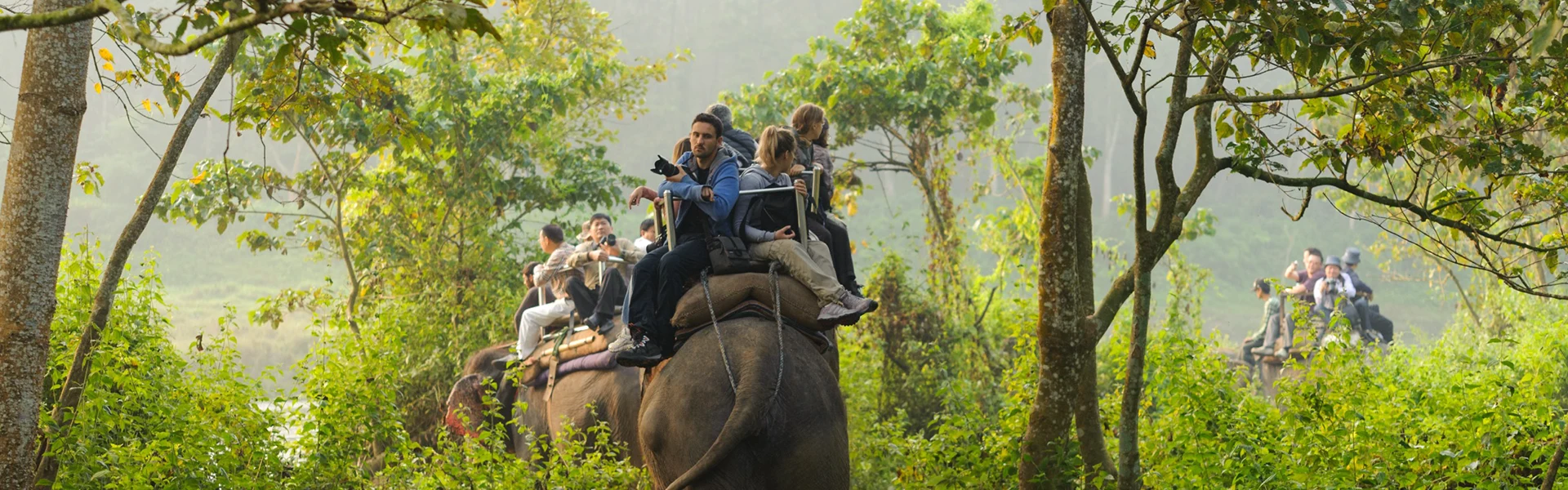
- Visit Chitwan National Park to see wildlife and the flora and fauna of the jungle.
Itinerary of Kathmandu Pokhara & Chitwan – 12 Days
Day 1: Welcome to Kathmandu!
You’ll get vistas of the valley, the Himalaya, and the terraced fields below as you soar into Kathmandu. After clearing customs, a representative will be there to welcome you outside the airport and help you navigate the initially disorienting tiny, winding streets of Kathmandu to your accommodation.
After you’ve settled in, go exploring in the city. The Kathmandu Durbar Square is an excellent site to start your trip because it is surrounded by tiny stores, historic temples, and neighborhood eateries. Swayambhunath, the white stupa standing above the valley, is the ideal location to watch the sun set over the valley if you want to get some exercise.
The evening is a nice time to eat, and Thamel, a popular tourist destination, offers a wide selection of eateries serving both Western and regional Nepali cuisine.

Day 2: Everest Mountain Flight, Explore Kathmandu
You’ll take an early-morning flight (1 hour) to visit Mount Everest and other impressive peaks in Nepal before breakfast. It is a breathtaking trip that travels to Mount Everest and back along the Himalayan range in the east. After being picked up from your hotel and transported to the domestic airport, you’ll return just in time for breakfast.
During the flight, look out the lefthand side of the plane to see famous peaks such as Shisha Pangma (26,289 feet / 8,013 m), Cho-Oyu (26,906 feet / 8,201 m), Nuptse (25,771 feet / 7,855 m), and finally Everest (29,029 feet / 8,848 m), known as ‘Sagarmatha’ by Nepalese and ‘Chomolungma’ by Tibetans.
You’ll have some free time to explore on your own after breakfast. You can unwind in the hotel or go for a quick stroll. Your experts can suggest some fantastic routes if you need some ideas.
You might choose to go on a guided tour in the afternoon (by private jeep) to some of the well-known cultural sites in the Kathmandu Valley. The following suggestions can help you make the most of your time in the city.
Flying time: 1 hour

Day 3: Drive from Kathmandu to Pokhara, Trishuli River Rafting
You will leave Kathmandu for Pokhara, the second-largest city in Nepal and location of Phewa Lake, after breakfast. The city, which is 2,713 feet (827 meters) above sea level, is the beginning point for several of Nepal’s well-known treks. Traditional villages and terraced fields are passed as the road winds along the Trishuli River’s banks.
You’ll stop on route for a 3-hour rafting excursion. The river is very secure and a fantastic place to start rafting in Nepal. After stopping for lunch along the way, you’ll arrive to a hilltop riverfront resort with breathtaking views. If staying on land is more your style, unwind at a wonderful riverbank hotel.
When you get to Pokhara, check into your accommodation, then stroll along the lakefront and unwind over supper.
Trishuli River
Given its proximity to Kathmandu, Pokhara, and Chitwan, the Trishuli is Nepal’s most well-liked rafting river. It features breathtaking canyons and thrilling rapids (easy to moderate). Its source is in Tibet, and it later becomes one of the Narayani river’s principal tributaries. The Trishuli’s ability to provide a fantastic ride in any season is one of its outstanding qualities. The river becomes more technical in the winter and has huge volume (though safe) waters during the monsoon.
Driving time (Kathmandu to Trishuli): 1-2 hours
Rafting time: 3 hours
Driving time (Trishuli to Pokhara): 3-4 hours

Day 4: Explore Pokhara
You’ll have all day today in Pokhara to unwind or take part in a range of activities. You might wish to check out the local eateries and coffee shops, go shopping, or try something more daring like paragliding or mountain biking.

Day 5: Trek from Phedi to Dhampus (1,750 meters)
After breakfast, you’ll be met by your guide at the hotel and driven for around 30 minutes to Suikhet Phedi, where the walk will begin. From here, the trail ascends rapidly through lovely terraced rice fields, a forest, and another woodland until arriving at the village of Dhampus.
You’ll spend the night at this teahouse in the Nepali Himalayas! Depending on the weather, views of the snow-capped peaks of Machapuchare (the revered, unclimbed Mount Fishtail), Annapurna South, Lamjung Himal, and Annapurna III can be seen from the teahouse.
Trekking time: 3 hours

Day 6: Trek from Dhampus to Landruk (1,900 meters)
After breakfast, you’ll hike through an orchid and rhododendron forest, home to a variety of bird species, to the village of Pothana and then on to Deurali. You may get fantastic views of the Himalaya, especially Mt. Dhaulagiri, the highest mountain in this area, from the ridge at Deurali.
Before descending through the forest to Tolka, a little, charming Gurung village steeped in culture, you’ll have time to take in the scenery and a well-deserved rest. On the way, lunch will be provided. The trail then descends through forest and settlements to Landruk once you reach Beri Kharka. In this huge Gurung community, which is located above the Modi River, you will spend the night in a neighborhood teahouse.
Trekking time: 4-6 hours

Day 7: Trek from Landruk to Nayapul (1,030 meters), Drive to Pokhara
After breakfast, you will make your way to Kimchi by descending via easy paved trails through a woodland and terraced fields. You will descend the ridge to Kehone Danda, continue through Kliu, cross a suspension bridge over the Sadhu Khola river, and then arrive at Seuli Bazaar.
From there, you can take a stroll along the Modi Khola, passing through picturesque terraces and woods as you make your way to Birethanti and then Nayapul on the Pokhara-Baglung route. Your car will be waiting in Nayapul for the hour-long trip back to Pokhara.
The remainder of the day is yours to do as you like after settling into your hotel. After your hike, you can unwind or visit some of Pokhara’s attractions before going out for dinner at one of the city’s many excellent restaurants.
Trekking time: 3-4 hours
Driving time: 1 hour
Accommodation: Teahouse

Day 8: Drive from Pokhara to Chitwan
You will go in your own private vehicle to Nepal’s renowned Terai region after breakfast. From what you have seen thus far and from the high, alpine portions of the Himalayan range, the landscape and culture are completely apart. The term “Terai” refers to the vast plains in the southern region of Nepal; this region is the furthest northern extension of India’s huge Gangetic plains; it was conquered and lost through years of conflict and possesses both Indian and Nepalese traits and cultural traditions.
You will eventually arrive in the huge plains and bright jungle of the Chitwan National Park in time for a late lunch. On the way, you will travel past terraced crops cultivated by generations of family members and through narrow, winding gorges and deep river valleys. You may unwind and enjoy the breathtaking vistas of this diverse country from the car on this gorgeous overland excursion.
Early in the afternoon, you’ll fly into Chitwan, where you’ll check into a hotel and meet a representative to go over the itinerary for your stay.
Driving time: 5-6 hours (91 miles / 147 km)

Day 9: Explore Chitwan: Safaris, Wildlife, and Relaxation
Choose from a selection of options today, or spend the day unwinding and adventuring on your own. The beautiful elephants of Nepal can accompany you on a full day of jungle safari excursions as you hunt for wildlife in the dense jungle. Alternatively, you can go on a river safari in historically accurate wooden canoes to see animals and birds along the river banks.
The bigger one-horned rhinoceros, spotted deer, hog deer, sambar deer, and barking deer are among the wildlife found in Chitwan. A large diversity of birds are also present. If you’re lucky, you might catch a glimpse of the leopard, sloth bear, and Royal Bengal tiger (although it’s getting easier to detect them lately!).

Day 10: Fly from Chitwan to Kathmandu
You’ll be taken to the Bharatpur airport after breakfast in Chitwan so that you can catch your flight back to Kathmandu.
After being driven to your accommodation in Kathmandu, the remainder of the day is yours to do as you like. Take a rickshaw, bicycle, or foot tour of the city’s streets to view anything you might have missed at the start of your trip or to look for souvenirs.
Flight time: 25 minutes

Day 11: Explore Bhaktapur: Ancient City of the Kathmandu Valley
One of the three cities in the Kathmandu Valley, Bhaktapur, is about nine miles (14 km) to the east of Kathmandu City, where you will be traveling after breakfast. True medieval art and architecture may be seen in this old city, also known as Bhadgaun, which translates to “the city of devotees” and is the location of the valley.
Enjoy lunch and people-watching in one of Bhaktapur’s historic squares; use your afternoon free time to unwind or explore. After that, you’ll be driven to your accommodation for the night.
Bhaktapur
Bhaktapur is fashioned like a conch shell and was established in the ninth century. Bhaktapur is the epicenter of traditional Nepalese woodcarving thanks to both its well-known peacock-carved windows and a museum devoted to the art form. This royal city is notable for being a historically true, traditional neighborhood; it is practically a living museum where farmers dry their produce, potters turn their wheels, and people go about their daily lives as they have for generations.
Driving time: 1.5 hours (round-trip)
Accommodation: Hotel

Day 12: Depart Kathmandu
The time has come to bid Nepal adieu. Take in your final minutes in Kathmandu with a breakfast in a café, a farewell stroll through the little lanes and temples, and some shopping for trinkets. At your hotel, a driver will be ready to take you to the airport for your trip back home. It’s better to arrive at the airport two hours or more before takeoff.

Frequently Asked Questions
Spring (March–May) and autumn (September–November) offer the clearest mountain views, pleasant temperatures, and ideal trekking conditions.
The trip is easy to moderate. City tours involve light walking, and the Panchase trek is a gentle hill hike suitable for beginners with basic fitness.
No. The Panchase route is a soft trek with gradual ascents, comfortable lodges, and professional guides, making it perfect for first-time trekkers.
You’ll stay in boutique hotels, heritage properties, a traditional village homestay in Panauti, and simple yet comfortable lodges during the trek
Yes. A licensed cultural guide accompanies sightseeing tours, and an experienced trekking guide supports you during the hike.
This itinerary includes a scenic domestic flight to Pokhara for comfort and time efficiency. Overland options are available on request.
Daily breakfast is included. Full board meals are provided during the homestay and trekking days. Lunch and dinner in cities are flexible for independent dining.
Yes. The route is safe and non-technical. Families and active seniors regularly enjoy this trek at a relaxed pace.
Absolutely. Paragliding, boating, ziplining, helicopter flights, and wellness experiences can be arranged as optional add-ons.
Comfortable walking shoes, light layers, a warm jacket for cooler evenings, sun protection, and a small daypack for the trek.
Yes. Comprehensive travel insurance covering medical care, trip delays, and trekking activities is strongly recommended.
Yes. We can personalize your journey with luxury hotels, private experiences, added destinations, or extended stays.